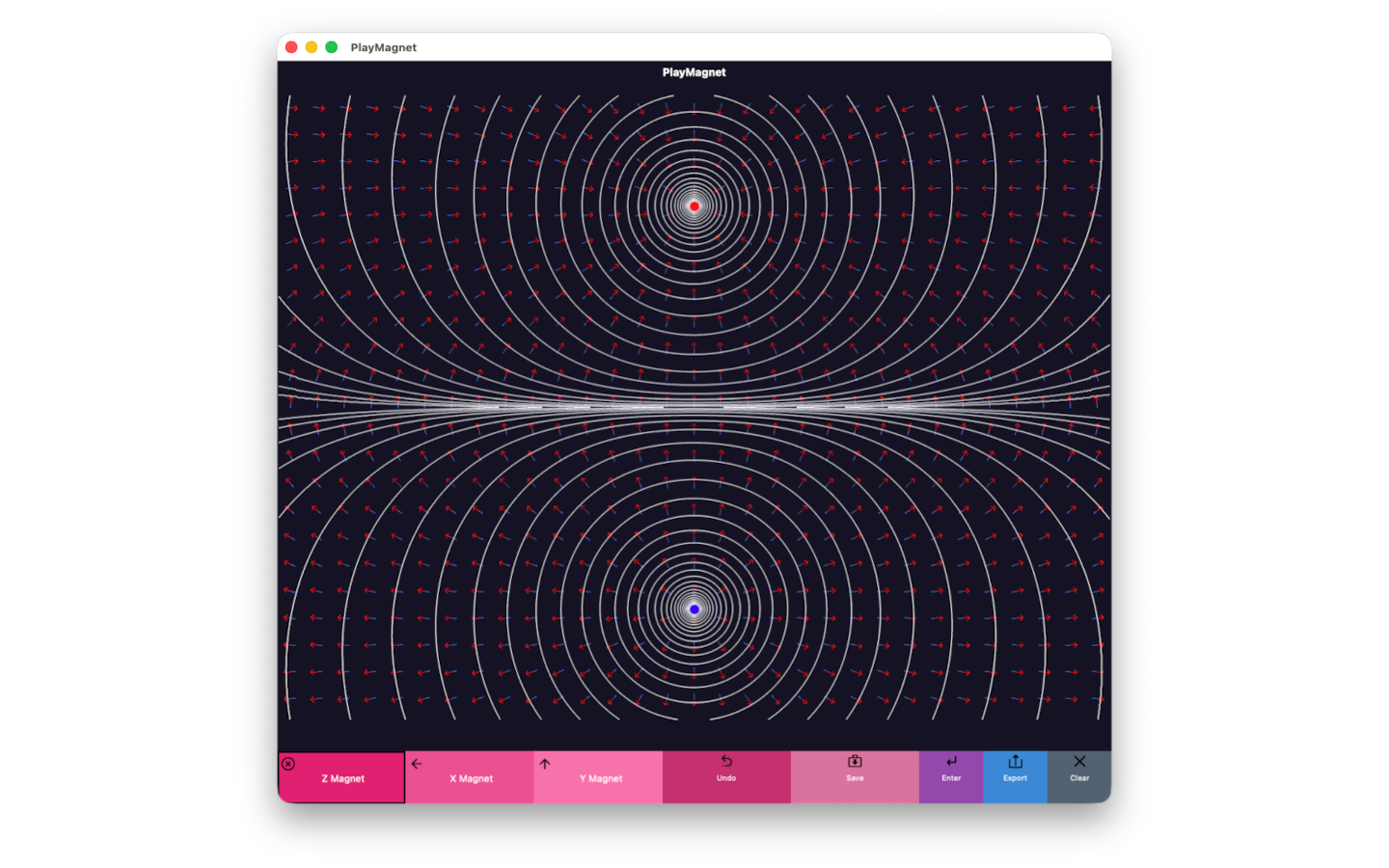
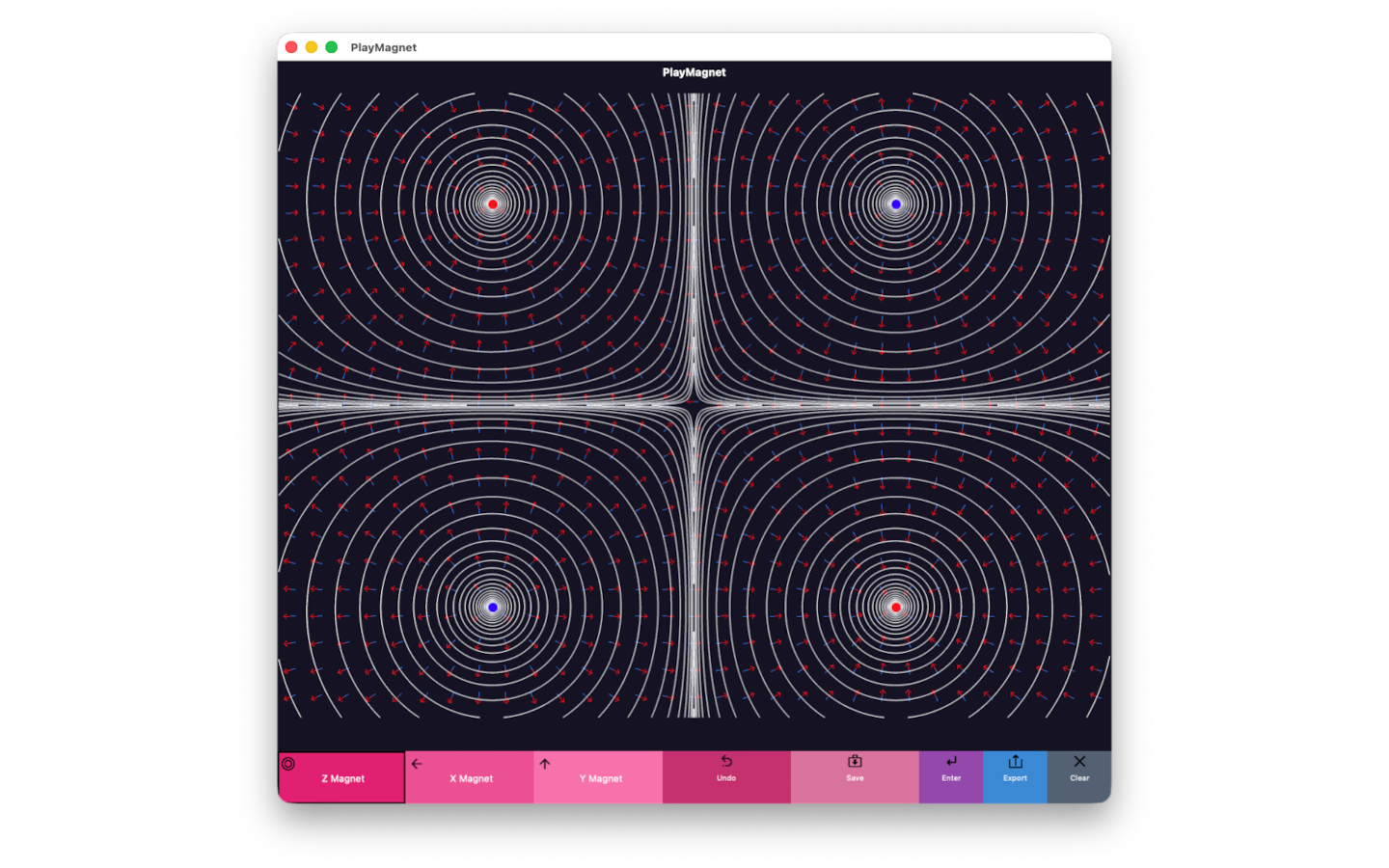
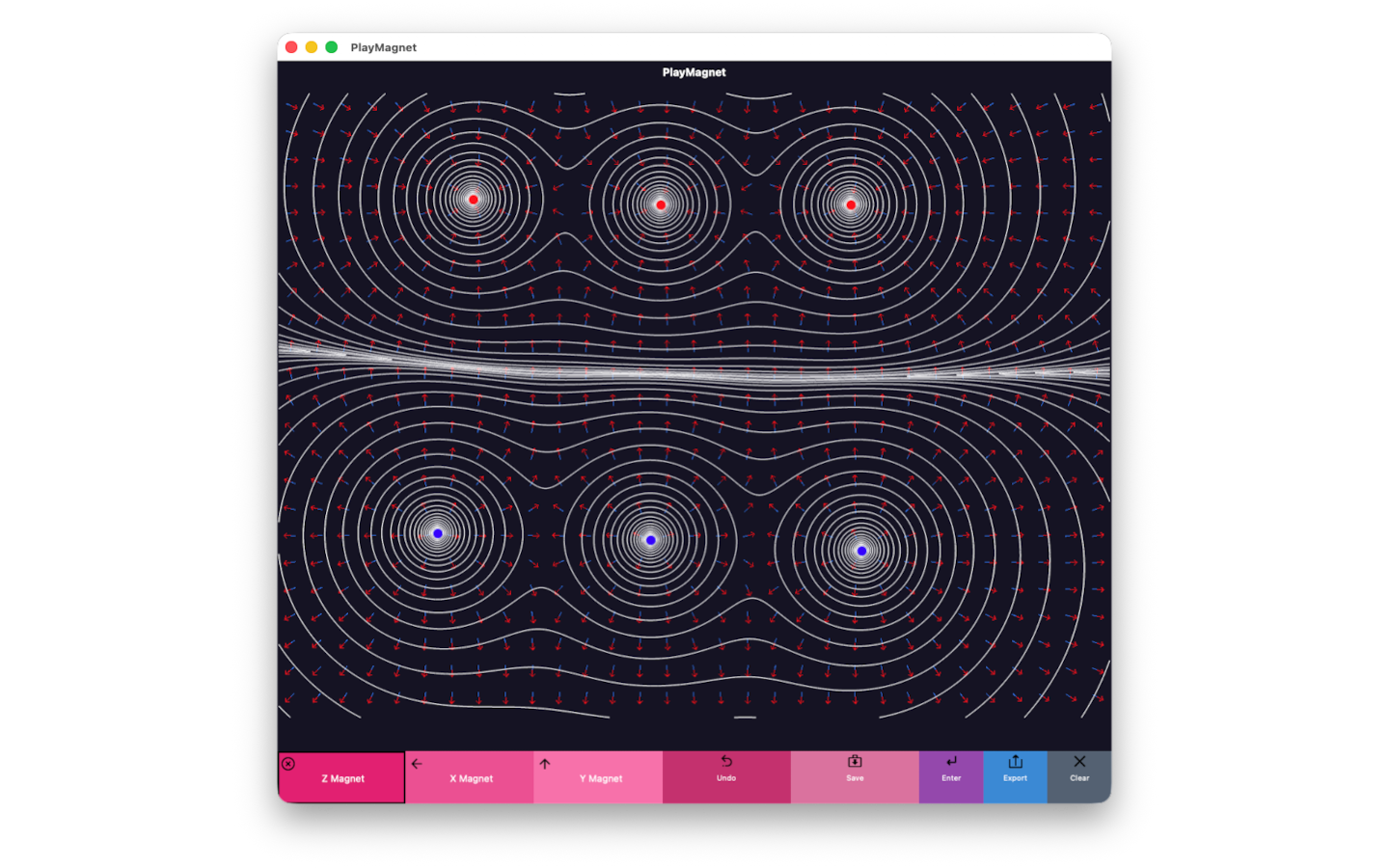
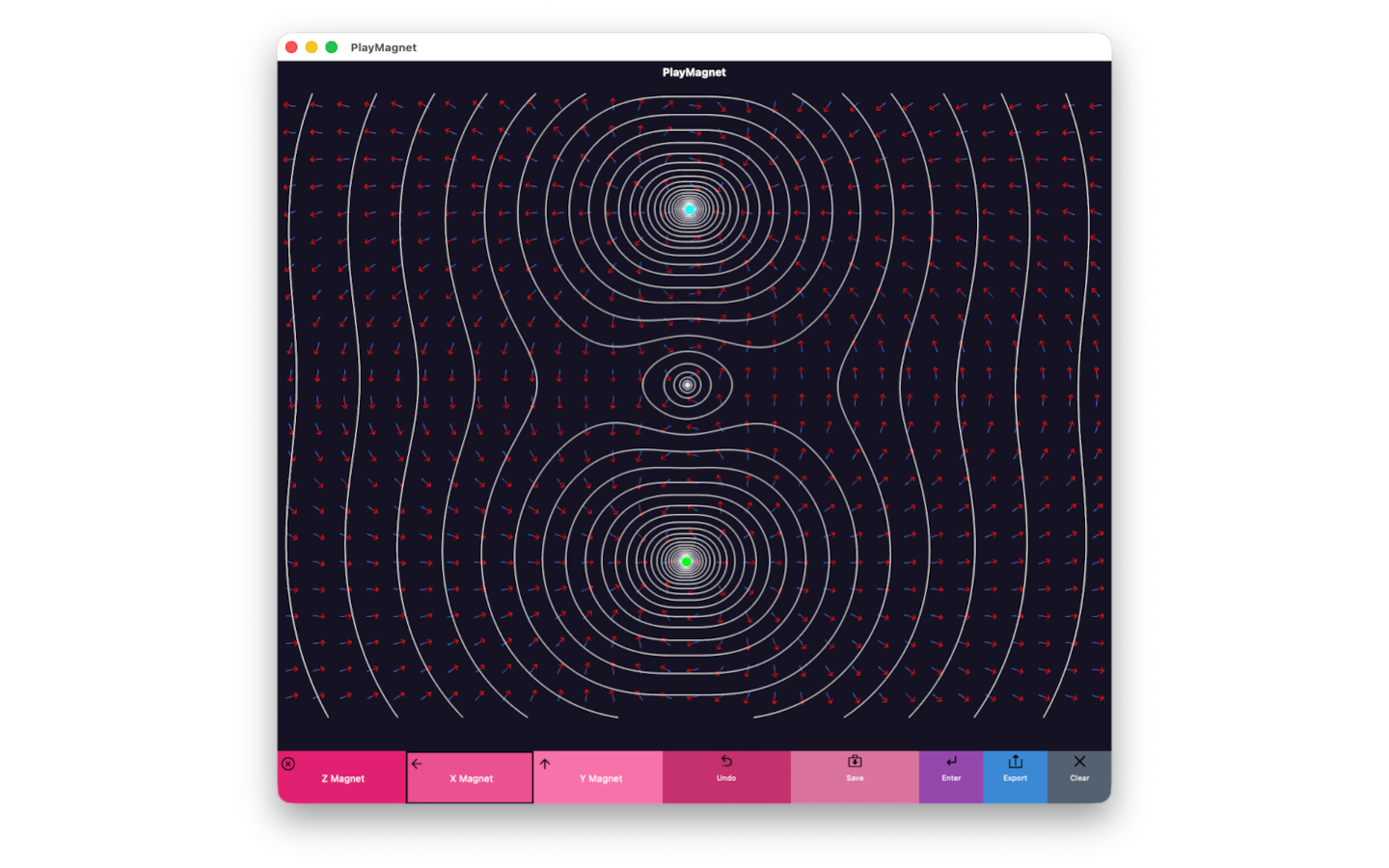
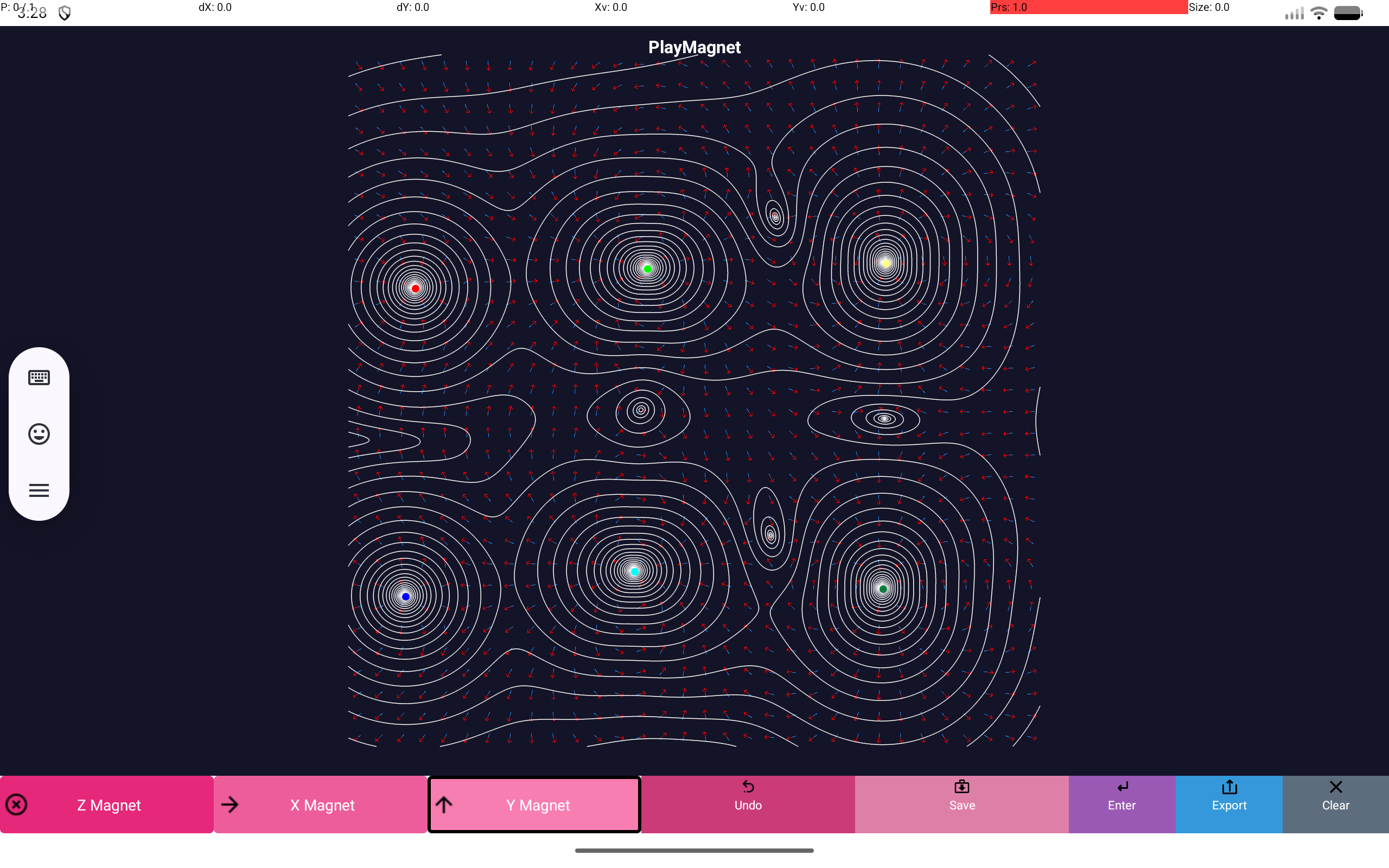
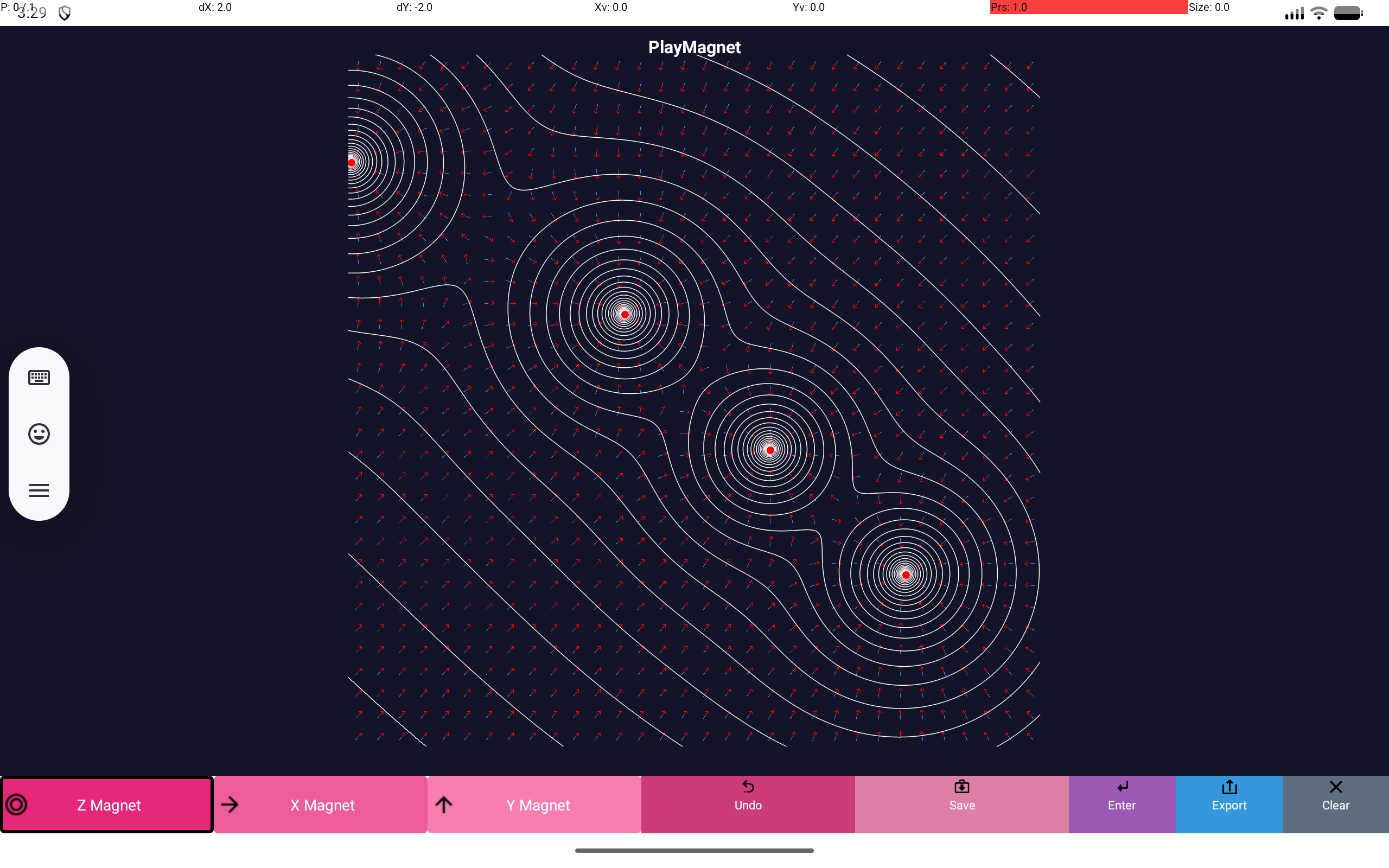
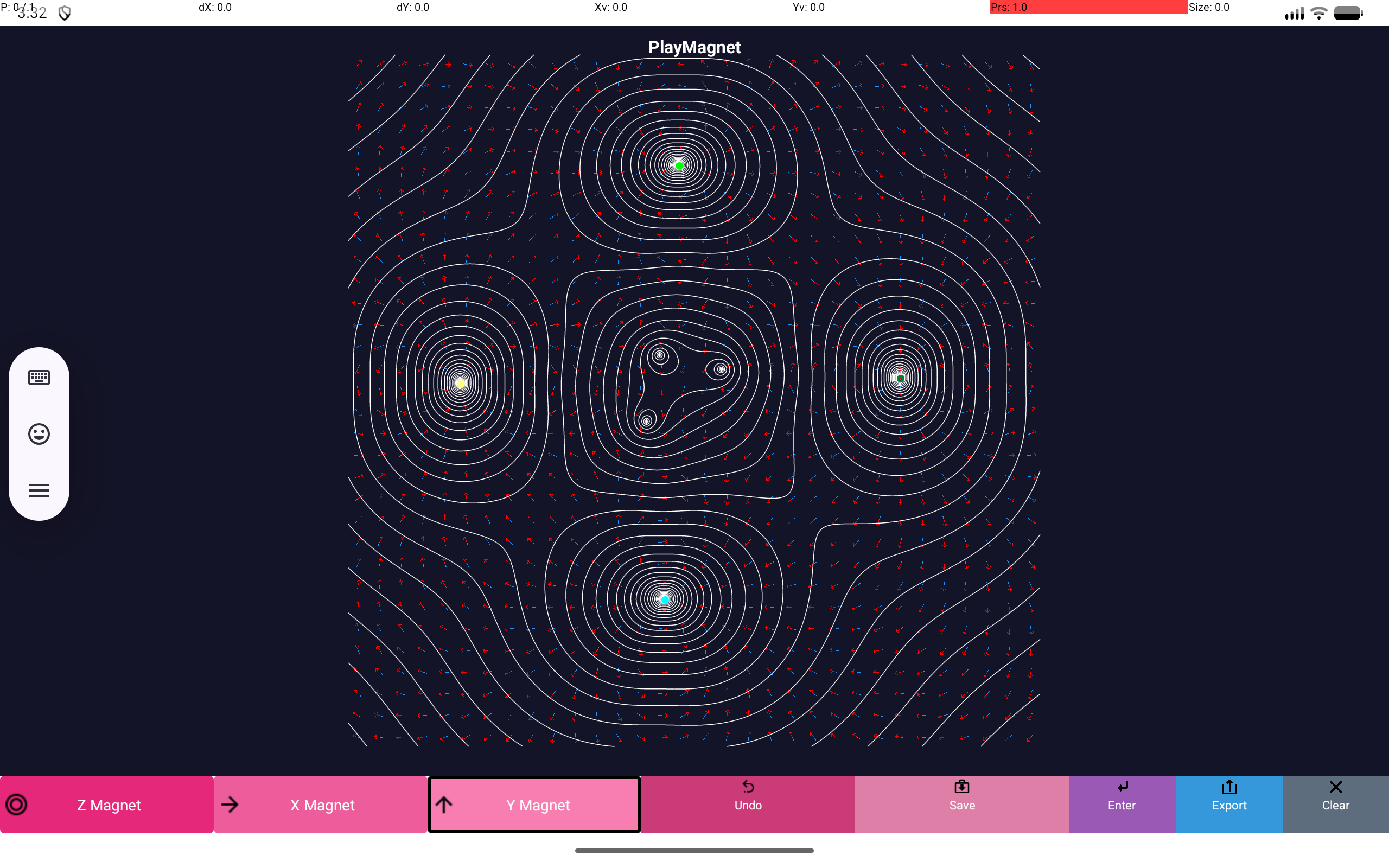
A beautiful, interactive magnetostatics visualizer that brings magnetic fields to life. Draw magnets with your finger and watch the fields unfold in real time.
Built on years of magnetostatics research, redesigned for today's devices.
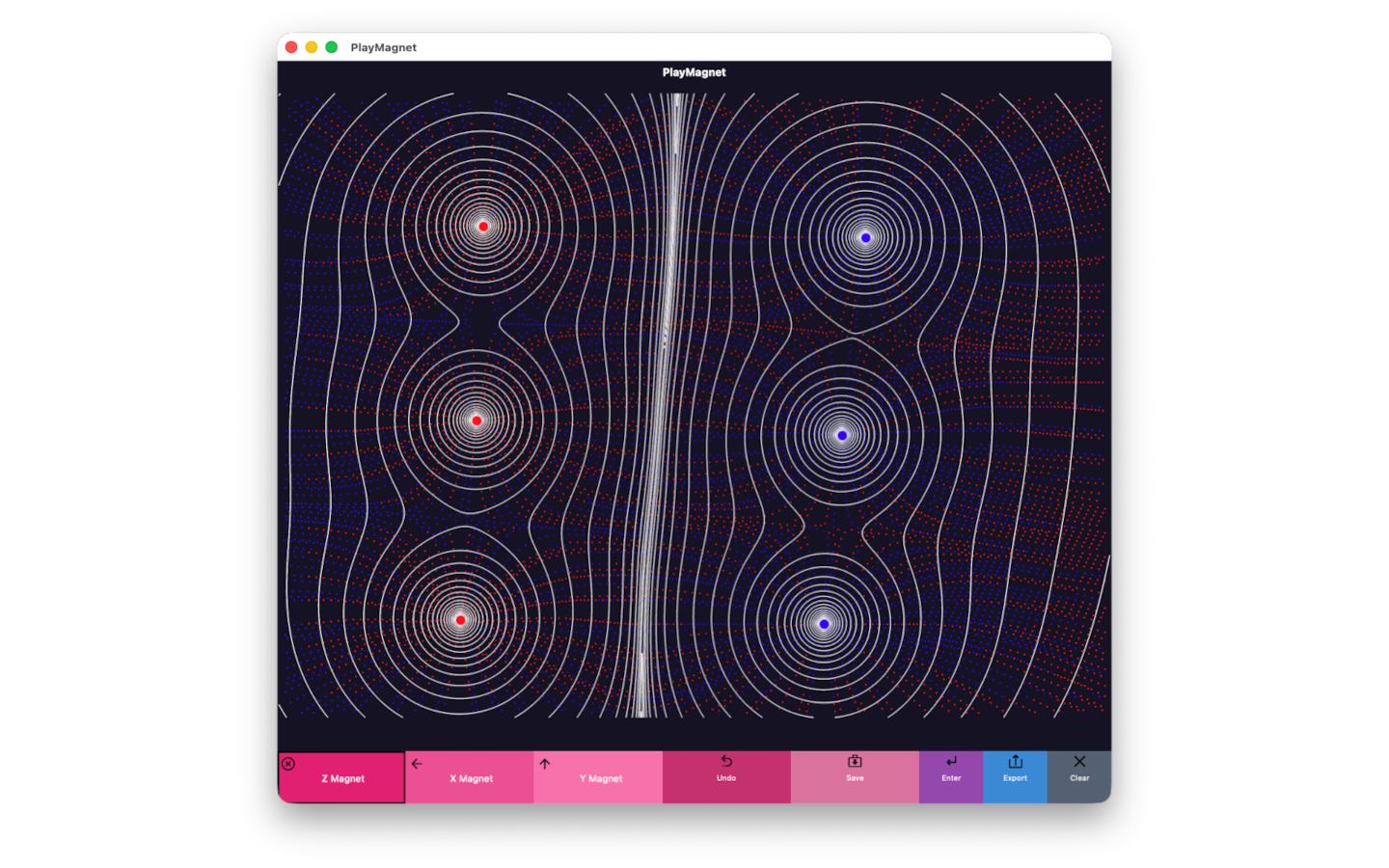
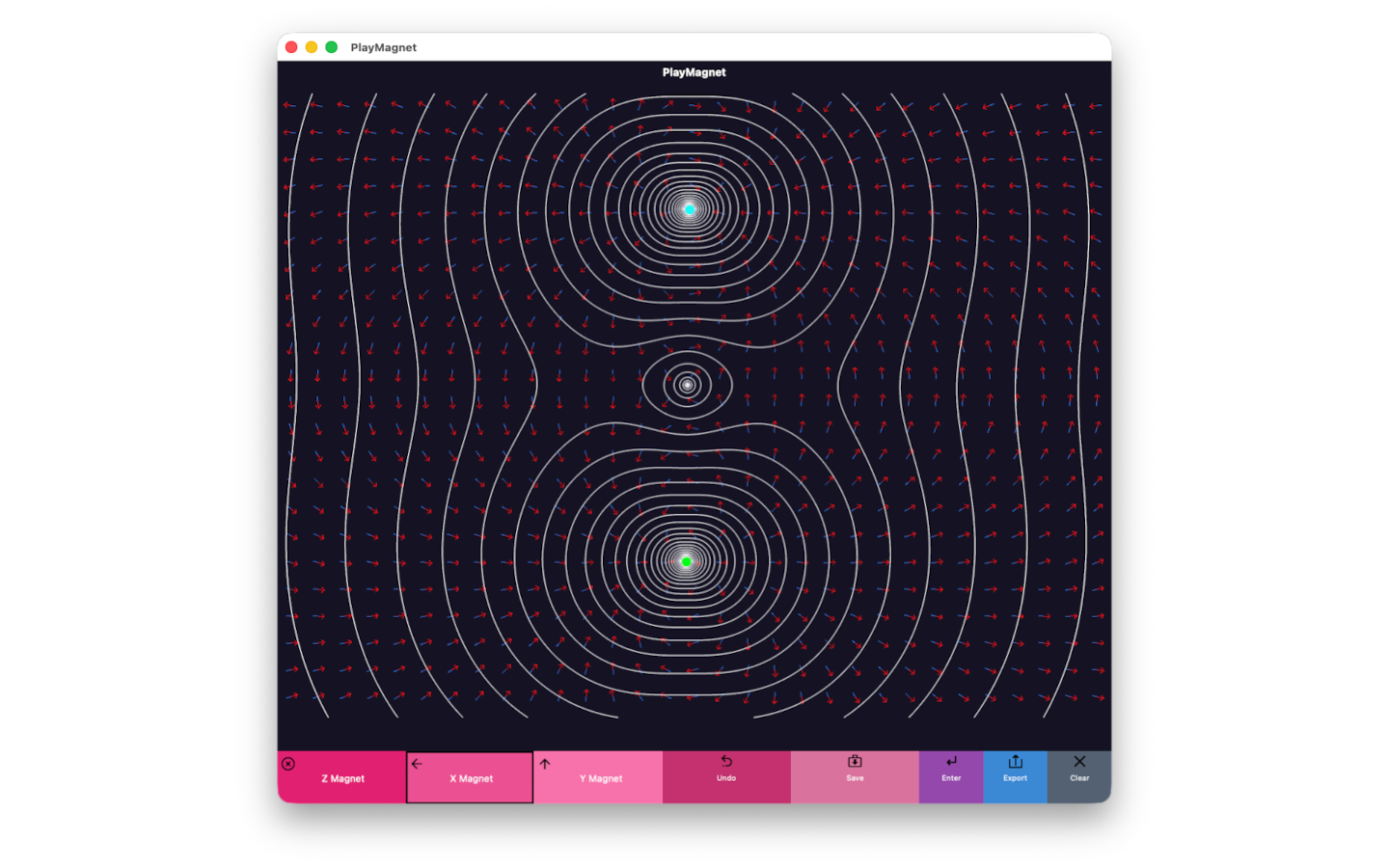
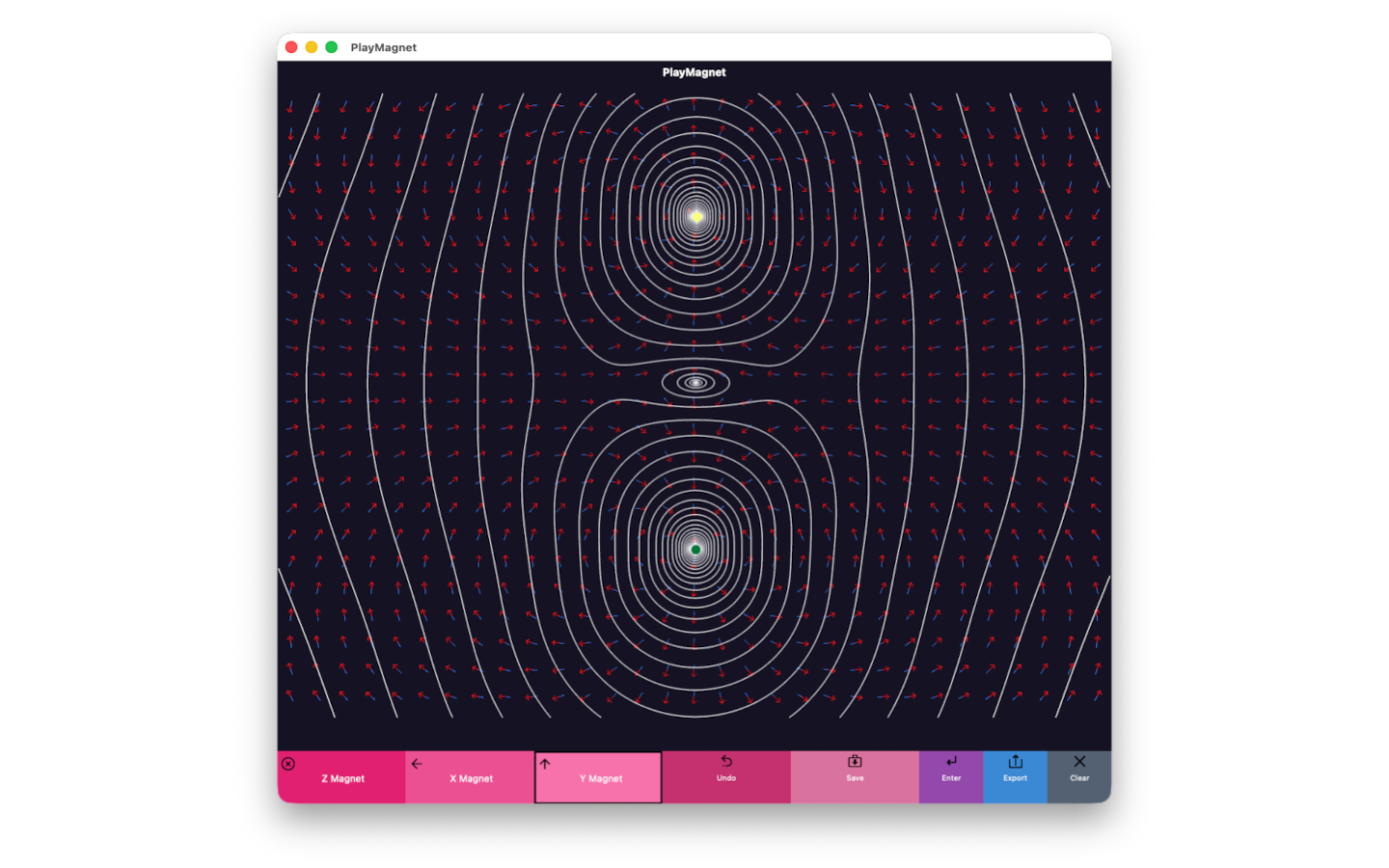
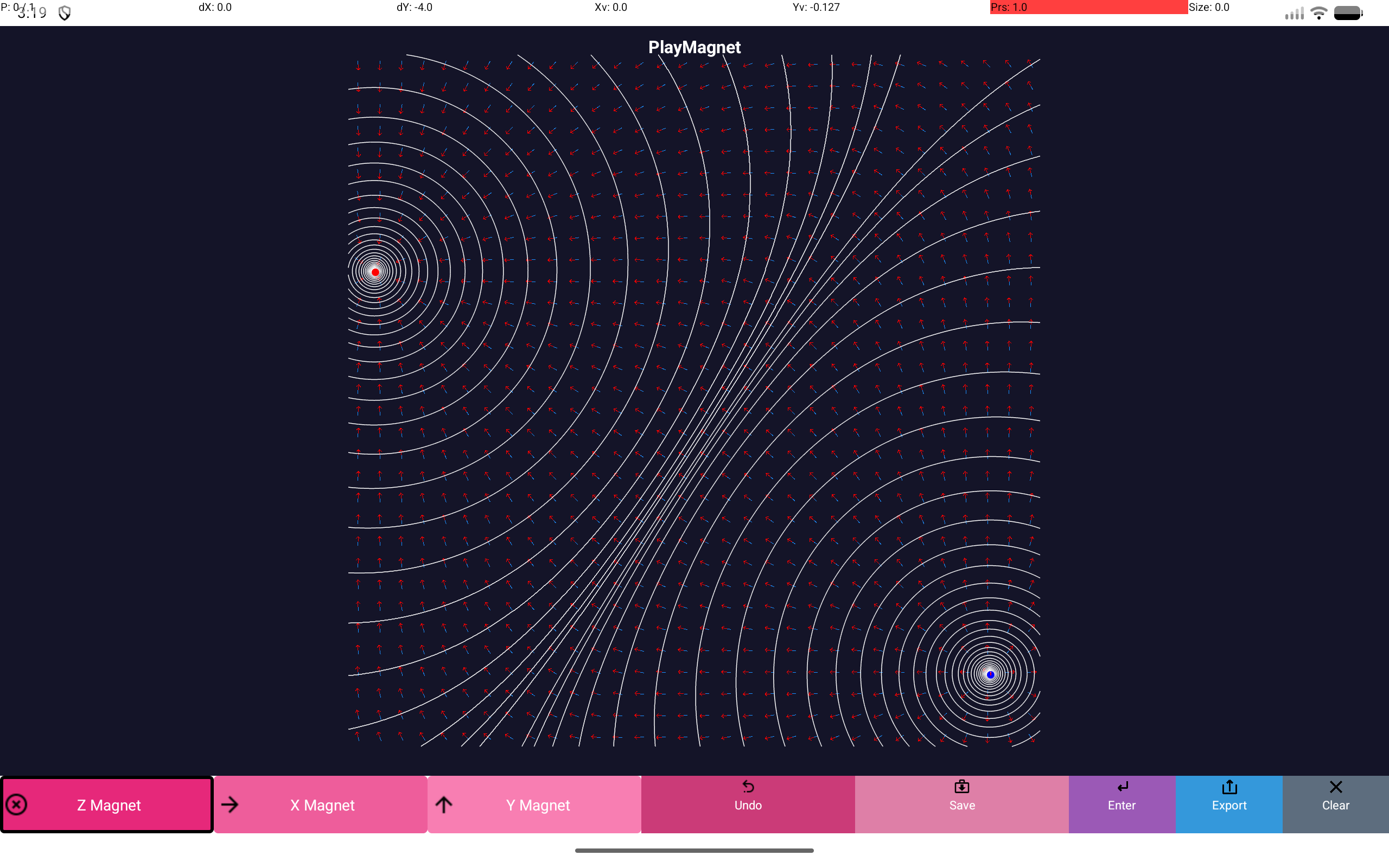
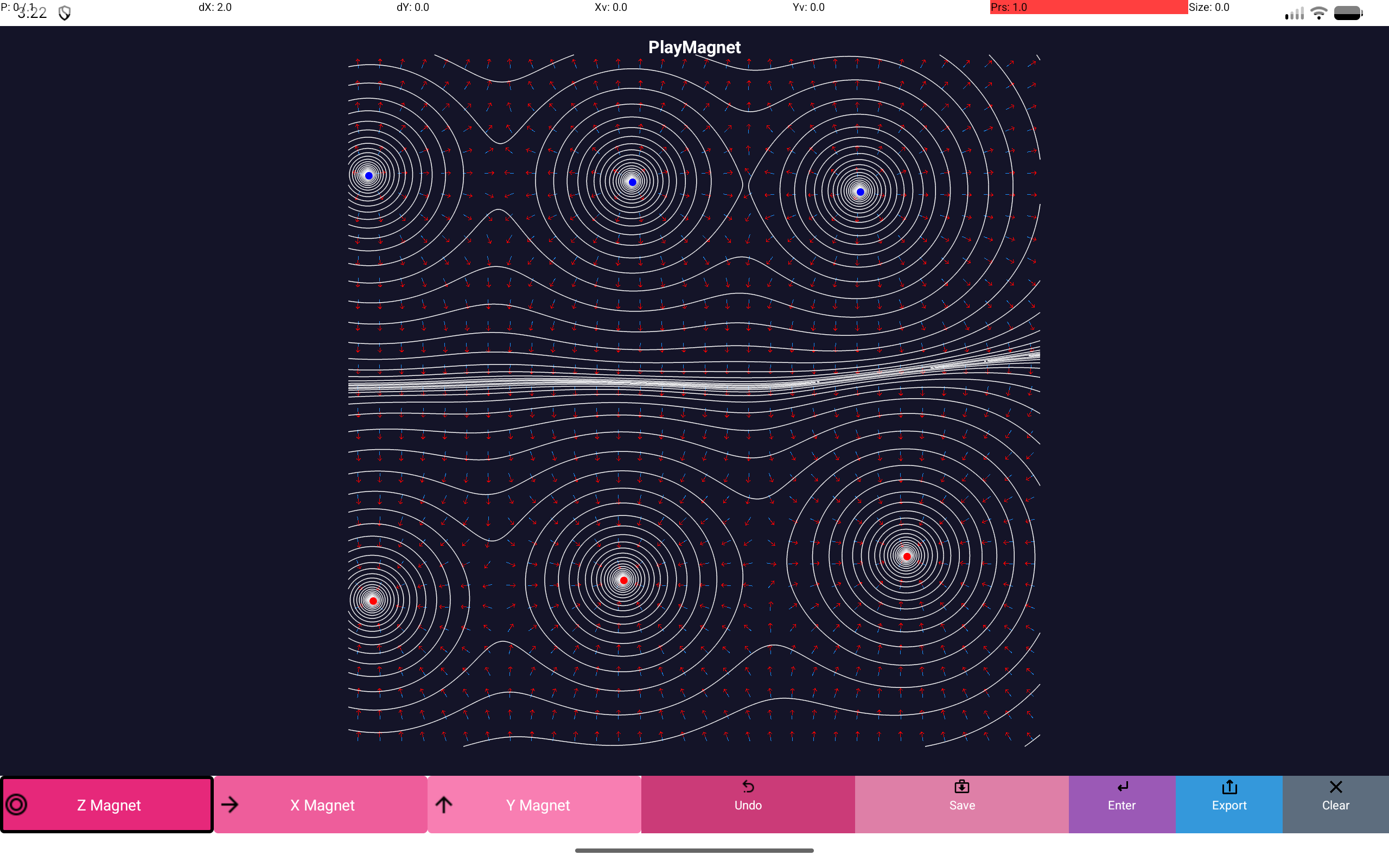
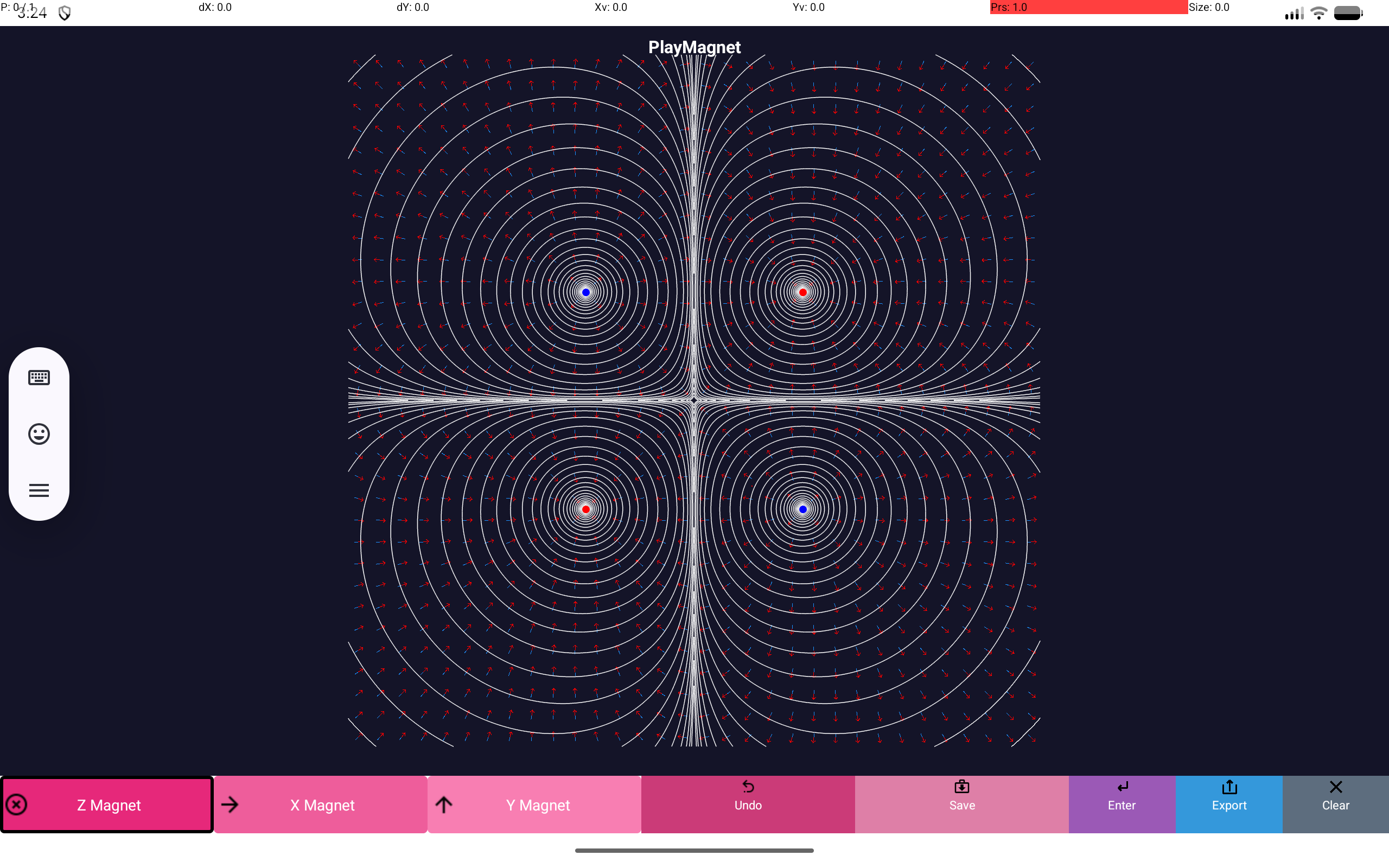
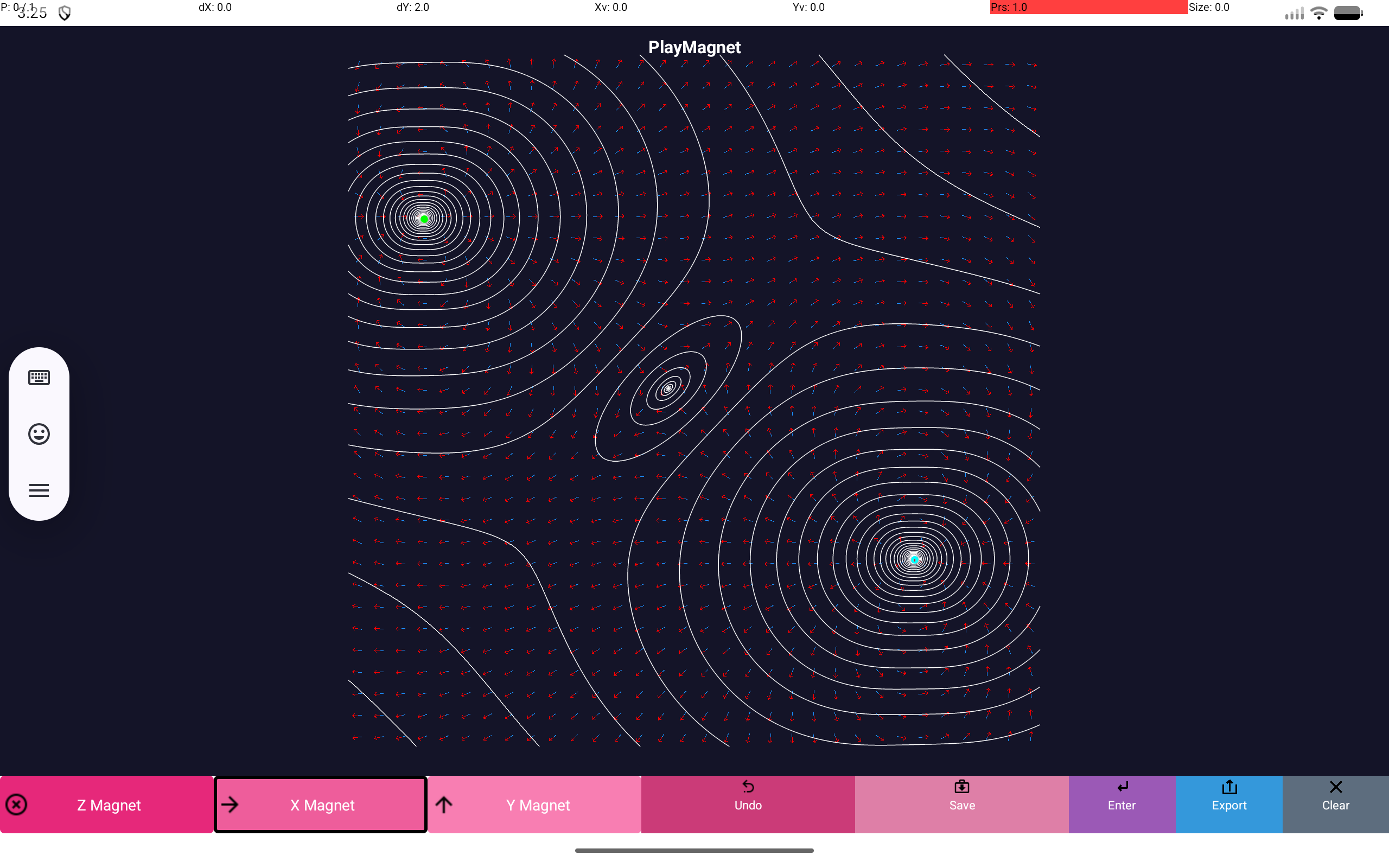
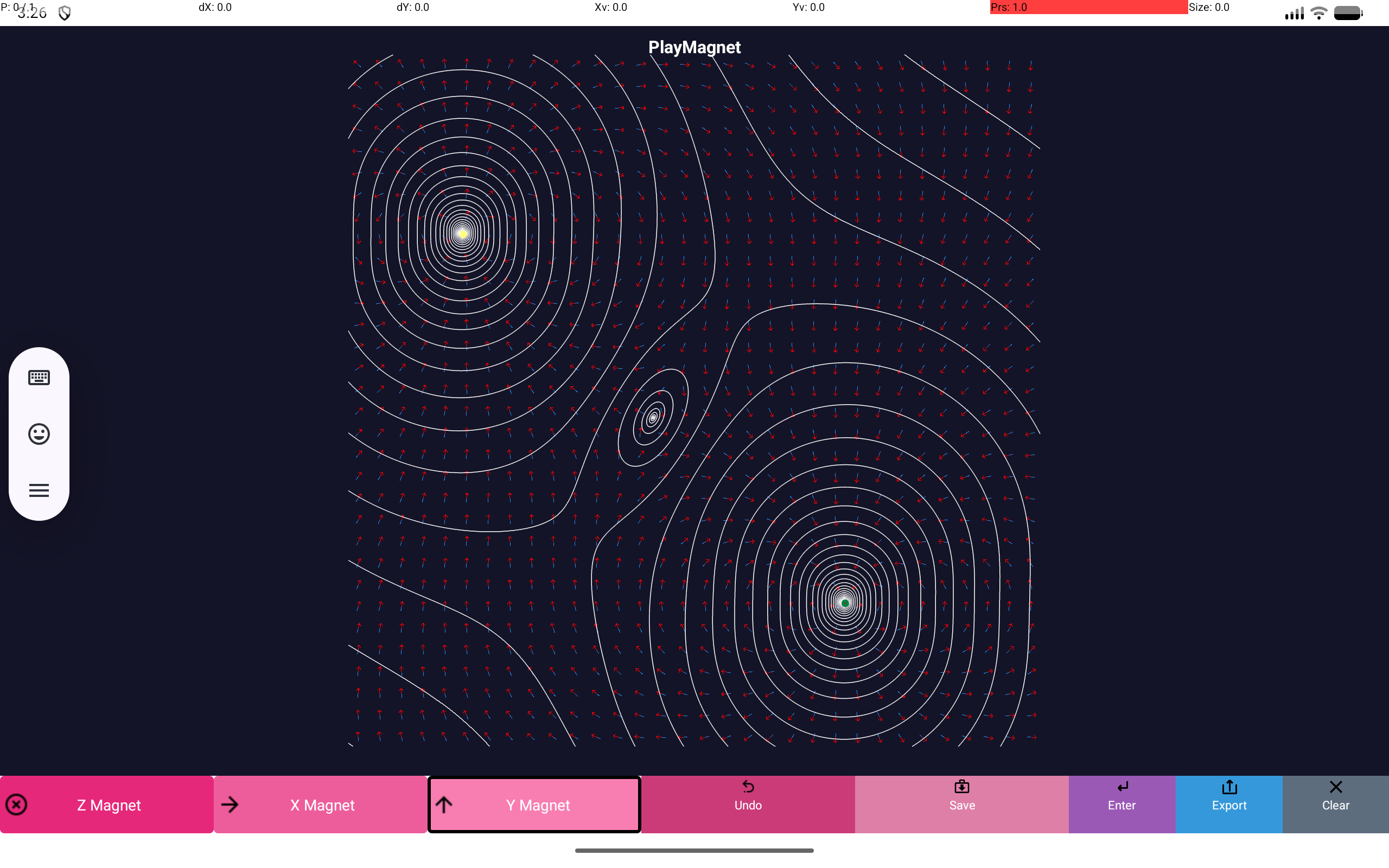
Watch vector fields, isopotential contours, and directional vectors calculate and render instantly as you place magnets.
Draw, drag, and manipulate magnetic charges with natural touch gestures. Zoom, pan, and explore fields at any scale.
Magnetic materials are represented by colors, making it easy to visualize and understand complex field interactions.
Export high-resolution screenshots of your field visualizations to share or use in presentations and research.
Available on iOS, Android, Mac, and Windows. Your magnetostatics work goes wherever you go.
Free classroom materials for teaching magnetic fields and isolines. Two printable grid worksheets challenge students to connect equal values and discover contour lines by hand. A third lesson brings it to life with PlayMagnet's interactive vector arrows.
PlayMagnet in action on iPad, iPhone, Mac, and more.
Mac — Native MacCatalyst app
Mac — Field visualization
Mac — Charge placement
Mac — Vector field display
Mac — Isopotential contours
Mac — Multi-charge interaction
Mac — Save & export
Android Tablet — Main view
Android Tablet — Field lines
Android Tablet — Charge interaction
Android Tablet — Vector display
Android Tablet — Dipole pattern
Android Tablet — Contour map
Android Tablet — Multi-charge
Android Tablet — Export dialog
Available on your favorite platforms. Start exploring magnetic fields today.
iPhone & iPad
→Android Phones & Tablets
→Windows 10 & 11
→macOS (Apple Silicon & Intel)
→
Certified on Educational App Store — safe for students & classrooms.
Learn how to get the most out of PlayMagnet.
Learn to draw magnetic dipoles freehand and build precise quadrupole arrays using the Enter button for exact coordinate placement.
A dedicated classroom workflow for scanning, processing, and printing student magnet drawings.
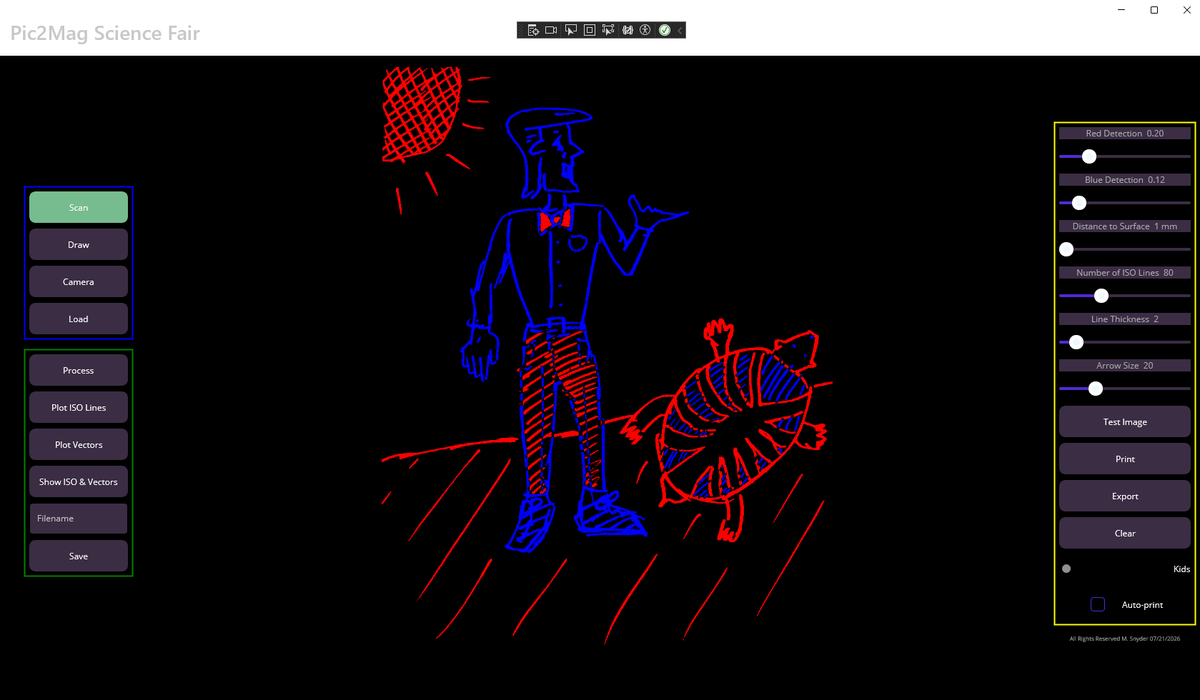
Pic2Mag Science Fair turns a flatbed scanner or classroom webcam into a hands-on magnetics lab. Students draw magnetic shapes with red and blue markers on ordinary paper; the teacher scans the stack one sheet at a time and Pic2Mag Science Fair automatically recovers the color-coded charges, calculates the field, and prints the result with a white background to save toner. The same pipeline works with saved images, a Windows webcam, or the built-in draw mode, so a single classroom PC can serve a whole science fair.
Printable worksheets for classroom, homeschool, and curious kids.
Isolines & Elevation
Students draw contour lines on a numbered grid by connecting equal values. Pick even numbers (0, 2, 4) or odd numbers (1, 3, 5) to map an island's shape. Ages 7+.
📄 Download PDFDipoles & Elevation
A hill on the left (+ numbers) and a dug-out hole on the right (- numbers). Draw isolines to see how they connect — just like a magnet's invisible field!
📄 Download PDFMagnetic Field Strength
Use PlayMagnet live to explore magnetic field strength with the "compass needle pinch" analogy. See how vector arrows show direction, isolines show equal strength, and find the neutral point where fields cancel out.
📄 Download PDFOriginal Pic2Mag versions and training materials for reference and older systems.
The original Pic2Mag field calculator for Windows XP. A piece of computing history.
Download (50 MB)PlayMagnet is the evolution of Pic2Mag, a magnetostatics program that uses colors to represent magnetic materials. Based on the array of magnetic moments, the program calculates vector fields, isopotential contours, and directional vectors in real time.
Originally developed for Windows XP, Pic2Mag has grown into PlayMagnet — a modern, cross-platform app built with .NET MAUI and SkiaSharp, delivering beautiful, responsive field visualization on phones, tablets, and desktops.
Whether you're a student learning electromagnetism, a teacher demonstrating field concepts, or a researcher exploring magnetostatic interactions, PlayMagnet makes the invisible visible.
Off-Topic Bonus — You Scrolled All the Way Down
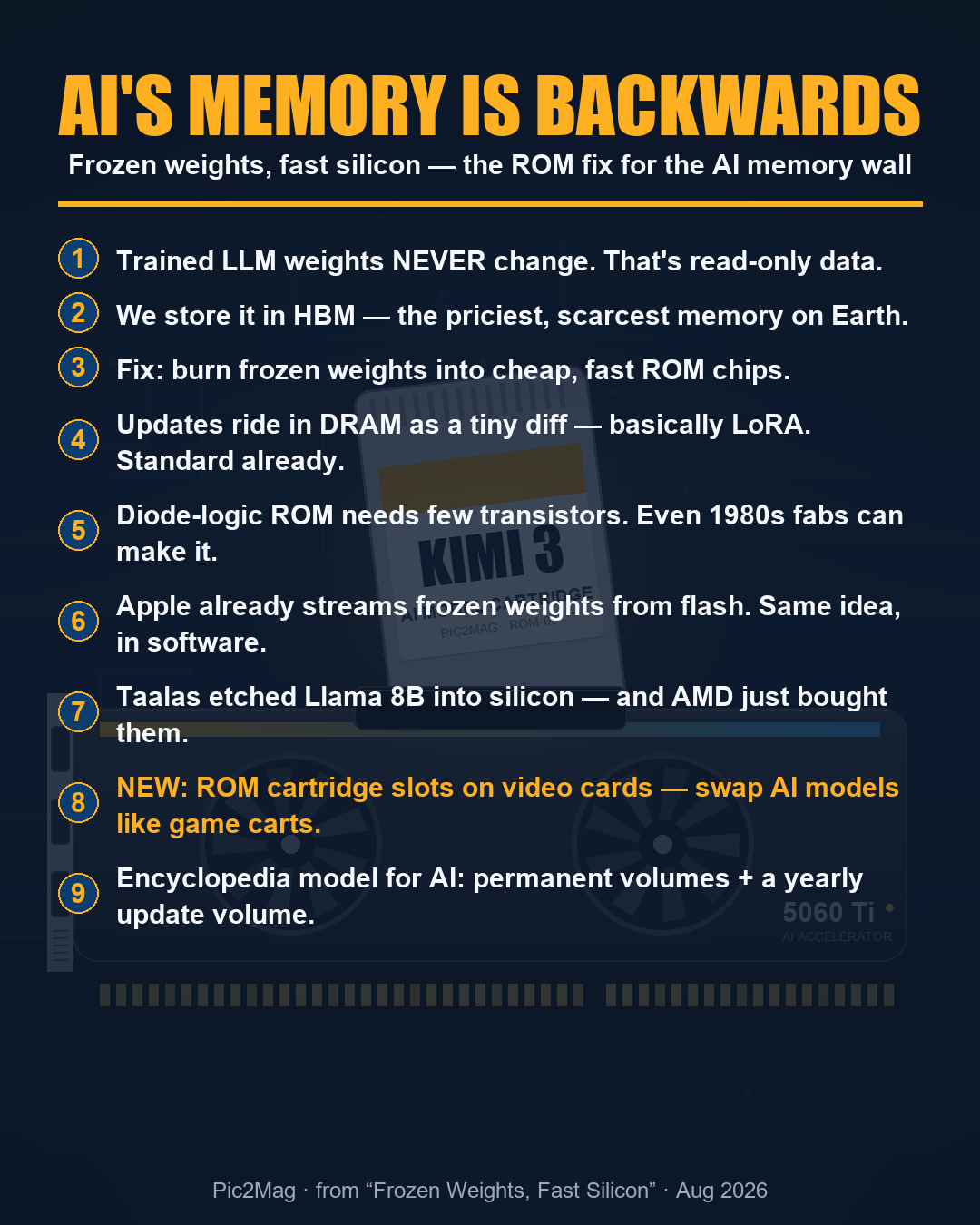
Not magnets — our other hobby project. A short whitepaper on why the AI memory shortage is partly self-inflicted.
The full paper goes further: LoRA diffs in DRAM, diode-logic mask ROM on mature fabs, swappable ROM cartridges for video cards, and a compression trick that multiplies bus speed.
Think ROM is too slow to feed a GPU? That's history talking, not physics — fast ROM is already possible using present technology. Our follow-up paper, Fast ROM at RAM Speed, shows why the wall never existed.
Off-Topic Bonus No. 2 — Still Not Magnets
Free tokens for life: a frozen LLM as a solar-powered appliance.
The goal is to set up an LLM as a local appliance that could be used in the middle of the jungle powered by solar cells, or maybe in the middle of the arctic during a really cold winter. Even from an older LLM model like Kimi 2.7, having free tokens for life could be really useful. Presently we think we always need the newest model, but Kimi 2.7 is still going to give valid answers for everyday life in the year 2040. The Oracle of Delphi has been on Mankind’s radar for thousands of years, and in 2026 we could make one.
Realizing that LLMs are mostly static weights, rom memory clearly plays a role in decreasing the cost of a computer that can run Kimi 2.7. The basic building block of ram memory is one capacitor and one transistor per bit, and the basic building block of rom mask memory is one transistor per bit. With the capacitor the circuit is a ram bank, and without the capacitor it is a rom bank. All the other chip specs stay the same and you gain some space (around 14%) because a rom bank does not need a refresh cycle and other things. Still the same bandwidth, still the same chip package.
So my first thought is equal numbers of ram banks and rom banks in a single memory chip which matches LLM models’ requirements pretty well. So you lose half the ram, but you gain equal rom and the chip total memory capacity increases by around 14 percent. From the model’s viewpoint it has gained memory because the static values are not changing anyway.
The second thought was rom only chips with the same bandwidth and packaging of modern ram, in that case you gain around 133 percent memory capacity per die because you do not need capacitors, refresh circuits, write paths, or rowhammer handling. Plus it runs at a lower power without the capacitor leakage.
In summary there is no free lunch here, trading ram banks for rom banks makes the specialized inference memory chip somewhat cheaper to produce, and the die more dense. The real trick here is producing a computer that exactly matches the requirements of a specific model with the right ram/rom mix ratio.
Even a 10% reduction in price could make specialized per model inference chips economical at the appliance level.

Click anywhere or press Escape to close